

You are scrolling through your feed and see “TFW you finally get a day off.” You pause. Is it a typo? A code?
It is neither. TFW is one of the most common abbreviations in online slang. This guide explains what TFW means in text, where it came from, and how to use it without sounding awkward.
Meaning & Definition
TFW stands for “that feeling when.” Merriam-Webster also lists “that feel when” and “that face when” as versions of the same phrase.
People use it to describe a relatable moment. The abbreviation sets up the scene, and the rest of the sentence completes it.
Quick facts:
- Full form: That feeling when
- Type: Internet slang/text abbreviation
- Tone: Casual, humorous, or emotional
- Typical format: TFW + a situation
What Does TFW Meaning in Text?
In a text or DM, TFW introduces a shared emotion. You are saying, “You know this feeling, right?”
It works the same way for good and bad moments:
- Happy: “TFW your favorite song comes on shuffle.”
- Frustrated: “TFW your phone dies at 1%.”
- Awkward: “TFW you wave at someone who wasn’t waving at you.”
The message rarely needs more explanation. The situation itself carries the emotion.
Background / Origin
TFW grew out of early meme culture on imageboards and forums. One common theory is that it came from an older meme built around the phrase “I know that feel, bro.” Over time, the shortened “that feel when” became “that feeling when” and then simply TFW.
Its cousin is MFW (“my face when”), which usually comes with a reaction image. Twitter, Tumblr, and Reddit helped TFW spread beyond niche communities and into everyday texting.
Usage in Different Contexts
TFW is flexible, but it doesn’t fit every situation.
Where it fits:
- Texting friends: “TFW the weekend finally starts”
- Group chats: “TFW everyone cancels plans”
- Social media captions: “TFW the coffee kicks in”
- Casual team chat (like Slack): fine if the workplace culture is relaxed
Where to skip it:
- Work emails to clients: use plain language instead
- Formal essays and reports: write out “the feeling of…”
Rule of thumb: if you would not use a meme in that setting, skip TFW.
TFW Meaning on Social Media Platforms
TFW is especially common on Twitter/X, where it appears in plain-text posts and in posts with images or GIFs. On TikTok, it often shows up as on-screen text while the creator acts out the scenario.
- X (Twitter): Short, punchy one-liners.
- TikTok: Text overlays on skits and reactions.
- Instagram: Captions and Stories, often with a GIF sticker.
- Reddit: Post titles and comment threads.
- Facebook: Less common, but used by younger users.
Other Meanings in Different Fields
Context decides everything with acronyms. Outside of texting, TFW can point elsewhere:
- Tactical Fighter Wing: a unit designation in the U.S. Air Force.
- Brand or product codes: some companies use TFW as an internal abbreviation.
If you see TFW in a military document or a product catalog, it is almost certainly not slang. Check the surrounding words before assuming.
What Does TFW Mean in Business?
There is no standard business meaning for TFW. In professional settings, it is just slang.
Some brands use it in social media posts to sound relatable, such as “TFW your inbox hits zero.” That works for marketing. Avoid it in contracts, reports, and formal emails.
What Does TFW Mean in Football?

TFW has no official meaning in football. Fans simply use the usual slang to react to a game.
Examples:
- “TFW your team scores in the final minute.”
- “TFW the referee misses an obvious foul.”
Fans also pair it with GIFs of celebrations or heartbreak. The Tactical Fighter Wing meaning does not apply here.
What Does TFW Mean in College?
College students use TFW constantly, mostly for shared struggles and small wins:
- “TFW the professor extends the deadline.”
- “TFW you realize the exam is tomorrow, not next week.”
It appears in group chats, memes, and student social accounts. It is also a quick way to bond over common experiences like all-nighters and cafeteria food.
What Does TFW Mean on iPhone?
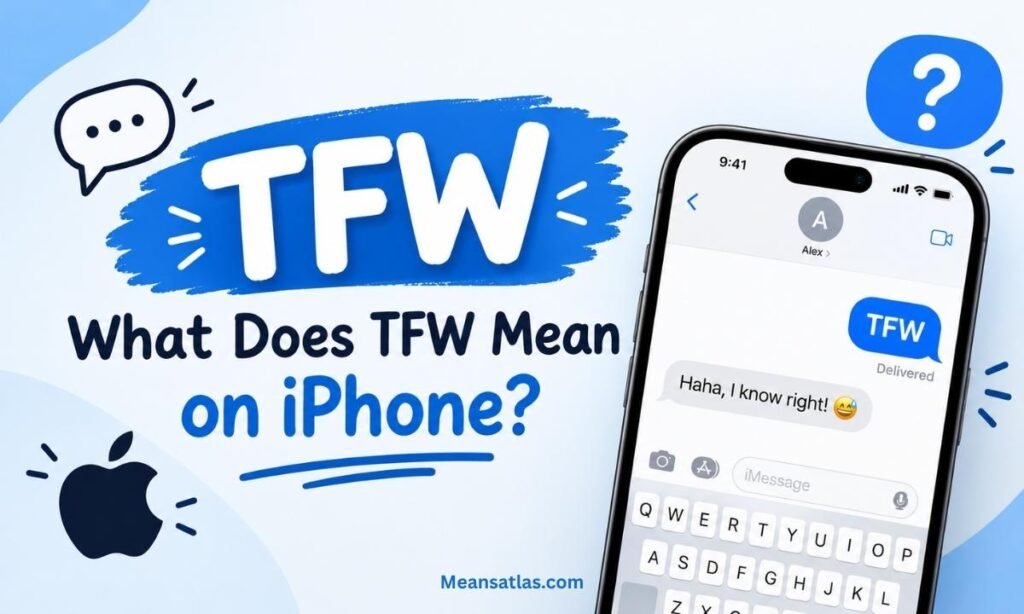
TFW means the same thing on an iPhone: “that feeling when.” Apple has not given it a special meaning.
If you type it often, you can save time. Go to Settings > General > Keyboard > Text Replacement and add a shortcut for the full phrase.
Examples of TFW Meaning in Text in Sentences
Relatable and funny
- TFW you open the fridge for the fifth time hoping new food appeared.
- TFW you say “you too” when the waiter says “enjoy your meal.”
Positive
3. TFW your payday notification arrives.
4. TFW you finally finish a long project.
Sad or frustrated
5. TFW you get left on read.
6. TFW your favorite show ends on a cliffhanger.
Tip: the best TFW lines describe a feeling most people have actually had.
Common Misconceptions
- “TFW always means something sad.” It does not. It covers joy, annoyance, embarrassment, and everything in between.
- “It needs a picture.” Text-only TFW posts are common and work well, especially on X.
- “It’s a question.” It is not. It is a setup for a statement.
- “It’s the same as ‘that’s how I feel.'” Not quite. TFW describes a situation, not just a mood.
- “It’s appropriate anywhere.” It is informal slang and should stay in casual spaces.
Similar Terms & Alternatives
- MFW (my face when): focuses on a facial reaction.
- MRW (my reaction when): usually paired with a GIF.
- IYKYK (if you know, you know): refers to an inside joke.
- Mood: a one-word reaction meaning “this matches how I feel.”
- SMH (shaking my head): shows disapproval.
- Relatable: a reply meaning “I feel the same,” not a setup.
How to Respond to TFW Meaning in Text When Someone Uses It
Match their energy. Here is a simple approach:
- Read the tone. Is the message funny, sad, or excited?
- React first. Use “Same!” or “I feel that” for a quick answer.
- Share your version. Reply with your own TFW: “TFW the Wi-Fi drops mid-meeting.”
- Offer support if needed. If it sounds like a rough moment, say “That’s rough, you okay?”
- Use a GIF or emoji when words feel like too much.
Example:
Friend: TFW you study for hours and still blank on the test.
You: Ugh, been there. Want to review together next time?
Difference Between TFW Meaning in Text and Similar Terms
The key difference is what each term focuses on.
- TFW describes a situation and feeling.
- MFW describes your face or reaction in that moment.
- Mood is a standalone reaction with no setup.
- IYKYK hints at shared knowledge, not shared emotion.
So “TFW you step on a Lego” sets up a scene, while “mood” would be your reply to it.
Relevance in Online Conversations & Dating Apps
On dating apps, TFW can lighten the mood. It shows humor and personality when used well.
Good examples:
- “TFW you match with someone who also loves bad puns.”
- “TFW the first message is just ‘hey.'”
What to watch:
- Keep it playful, not sarcastic or negative.
- Do not overuse it. One or two per conversation is plenty.
- Skip it with someone who writes in a very formal style.
Used sparingly, it makes you sound relaxed and relatable.
Frequently Asked Questions
What does TFW stand for?
TFW stands for “that feeling when.” It also appears as “that feel when” or “that face when.”
Is TFW formal or informal?
It is informal slang, best for friends and social media. Avoid it in professional writing.
Is TFW the same as MFW?
No. TFW describes a feeling or situation, while MFW describes your facial reaction.
Can I use TFW without a picture or GIF?
Yes. Plain-text TFW posts are very common.
Is TFW still popular?
Yes. It remains widely used on X, TikTok, Reddit, and in group chats.
Does TFW mean something different on iPhone or Android?
No. The meaning is identical on every device and platform.
Can TFW have a negative meaning?
Yes, but only through context. The acronym itself is neutral.
Conclusions
TFW means “that feeling when,” and it is a quick way to share a relatable moment. It works for humor, frustration, joy, and everything in between.
Keep it casual, pick situations people truly recognize, and avoid it in formal settings. Do that, and your TFW messages will land every time.

John Marvel is a passionate writer with a strong interest in the meanings of words, phrases, slang, and everyday expressions.
He enjoys researching language and sharing his knowledge to help people understand confusing terms more easily.
His goal is to provide simple, clear, and useful explanations that readers can easily understand and apply.
Through MeansAtlas.com, John shares helpful language insights to make learning and communication easier for everyone.