
You see “GPI” under a friend’s photo and wonder what it means. It looks like a typo, but it’s not. Here’s a simple guide to what GPI means, how people use it, and when to skip it.
What Does GPI Mean in Text?
GPI means “gracias por invitar.” That’s Spanish for “thanks for inviting.” People use it as a joke when they feel left out and weren’t invited. You’ll see it on WhatsApp, Instagram, Facebook, and TikTok.
GPI Meaning in Text Explained
On paper, GPI says “thanks for the invite.” But in real chats, it’s mostly a joke. The thanks is fake; the point is, “Hey, you forgot me!”
It started as a normal thank-you, but now it mostly carries a sarcastic edge.
Is GPI an Acronym, Short Form, or Slang?
It’s all three. GPI is an initialism, a short form, and internet slang. Spain’s Royal Academy (RAE) says it’s informal shorthand for online chats, not a true abbreviation. So keep it for texting.
Is GPI a Phonetic Spelling?
No. It isn’t spelled the way it sounds. You just say the letters: “G-P-I.”
Is GPI Meme-Based Slang?
Kind of. It spreads through memes and as a way to jump into other people’s posts. But memes didn’t create the meaning.
Is GPI a Typing Variation?
Yes. It’s a quick way to type a longer phrase. You might also see “gpi” in lowercase or “gpiii” for extra drama.
GPI Meaning Across Platforms
The meaning stays the same everywhere. Only the setting changes.
GPI Meaning on Snapchat
Friends reply “GPI” to snaps or stories from hangouts they missed.
GPI Meaning on TikTok
It shows up in comments on trips, parties, and food videos. Most of the time it’s a joke.
GPI Meaning on Instagram
People drop it under stories and group photos. A laughing emoji usually follows.
GPI Meaning on WhatsApp
In group chats, it can be a real thank-you or a joke about being left out. Spanish-language media say it can be used on any social platform.
GPI Meaning in SMS
It works in texts too. Without a photo, context matters. If someone texts “GPI” after hearing about your trip, they’re teasing.
GPI Meaning on Facebook
Family and old classmates use it under event photos. Here it’s more likely to be a real “thanks.”
GPI Tone and Context Variations
Tone changes everything. The same three letters can feel warm or cold.
Funny Tone
- How it sounds: Light teasing
- Example: “Beach day without me? GPI 😂”
Sarcastic Tone
- How it sounds: A sharp jab
- Example: “Great party. GPI.”
Romantic Tone
- How it sounds: A playful pout
- Example: “Dinner date and I’m not there? GPI 🥺”
Angry Tone
- How it sounds: Cold and short
- Example: “Wow. GPI.”
Playful Tone
- How it sounds: Cheeky
- Example: “GPI, next time I’m coming”
Hurt Tone
- How it sounds: Quiet disappointment
- Example: “GPI… I guess I wasn’t on the list”
GPI Meaning in Medical
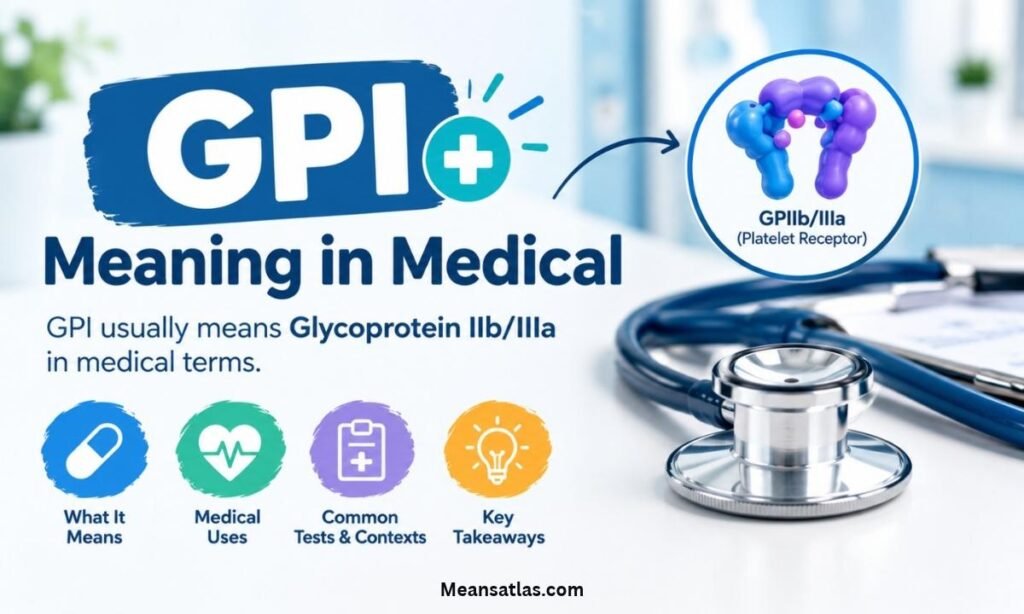
In science, GPI often means glycosylphosphatidylinositol. It’s listed as an acronym for this chemical term. It’s a molecule that helps attach proteins to cell surfaces. Older medical texts also use a retired term, “general paresis of the insane.”
GPI Meaning in Banking
In finance, GPI can be a company name. Legal documents use it for Global Payments Inc., and one loan agreement lists Insurance Company GPI Holding among insurers. It’s not a standard banking term, so check the document.
GPI Meaning in Education
In education, GPI usually means the Gender Parity Index. It compares girls’ access to education with boys’, as a ratio of girls to boys. A value of 1 means equal access. It is not the same as GPA.
GPI Meaning in Business
In business, you may see two meanings:
- Genuine Progress Indicator: an economic measure some US states, like Maryland and Vermont, use next to GDP.
- Company names: such as Graphic Packaging International, Inc.
GPI Meaning in Construction
There’s no well-known construction meaning for GPI. It may show up as a company or product name. One example is Great Plains Industries, which makes fuel transfer pumps and meters. Always check the project papers.
Real Chat Examples Using GPI
Example 1: Friends Going Out
Maya: (posts club photo)
Sara: GPI 😒
Example 2: Instagram Story
A friend replies to your beach story: “GPI, I see how it is.”
Example 3: TikTok Comment
Under a picnic video: “GPI, I love picnics!”
Example 4: WhatsApp Group
Ali: Lunch was great today.
Zoya: GPI, I was in a meeting 😭
Example 5: Birthday Plan
Hira: The cake was amazing!
Noor: GPI. Next year I’m inviting myself.
Example 6: Playful Reply
Dan: Movie night was fun.
Leo: GPI 😄 Save me popcorn next time.
Example 7: Sarcastic Mood
Rita: Team dinner was lovely.
Sam: GPI. Truly.
Example 8: Food Post
You post a burger. A friend comments: “GPI, where’s mine?”
Example 9: Family Chat
Cousin: Photos from the wedding dinner!
Aunt: GPI, beautiful pictures.
Example 10: School Friends
Zain: Study session was productive.
Omar: GPI, I’d have brought snacks.
Example 11: Romantic Chat
“You got ice cream without me? GPI 🥺❤️”
Example 12: Group Chat
Eli: Anyone up for karaoke tonight?
Jo: GPI. I heard it was epic.
Example 13: Light Joke
“GPI for the invite I never got, but I forgive you.”
Example 14: Annoyed Tone
Kim: We had a blast!
Tia: gpi.
Example 15: Friendly Reminder
“GPI, remember to invite me next time 😉”
GPI Grammar and Language Role
Part of Speech
GPI acts like an interjection. It’s a quick reaction, not a full word with grammar rules.
Sentence Role
It stands alone as a comment or ends a short message.
Does GPI Replace a Full Sentence?
Yes. It means “Thanks for inviting me… not.”
Sentence Position
It usually comes first or last: “GPI, next time!” or “Looks fun. GPI.”
Formal vs Informal Usage
It’s informal only. The RAE says it belongs to casual online chats.
Tone Impact
Emojis, punctuation, and capital letters change how it feels.
How to Reply When Someone Says “GPI”
Funny Replies
- “You’re on the list next time. Promise 😂”
- “Sorry, it was a secret mission.”
Serious Replies
- “Sorry, it was last minute. I should have called.”
- “That’s fair. I’ll include you next time.”
Flirty Replies
- “Next time, you’re my plus one 😉”
- “Come with me next time?”
Neutral Replies
- “It was a small group.”
- “Noted.”
Friendly Replies
- “Let’s plan something this weekend!”
- “You’re invited to the next one.”
Is GPI Rude or Bad?
Is GPI Rude?
Usually not. Most of the time it’s teasing. It feels rude only when the tone is cold or angry.
Is GPI Disrespectful?
Rarely. With someone you barely know, it can sound passive-aggressive.
Is GPI a Bad Word?
No. It has no swearing in it.
Can You Use GPI in School?
In chats with classmates, yes. Skip it in essays and emails to teachers.
Can You Use GPI at Work?
Avoid it in work messages. A relaxed chat with close coworkers is the only maybe.
Who Uses GPI?
Age Group
Teens and young adults use it most. Coverage says it’s more common among young users.
Gen Z vs Millennials
Gen Z uses it as everyday slang. Many millennials know it but use it less.
Regions
It’s Spanish slang, so it’s most common in Spanish-speaking places. Reports come from Mexico, Peru, Colombia, and Argentina.
Most Common Platforms
WhatsApp, Instagram, Facebook, and TikTok.
Origin and Internet Culture Behind GPI
Why GPI Became Popular
It’s fast to type, and sarcasm fits easily in three letters.
Meme Influence
Memes and comment sections helped GPI spread.
TikTok Trend Connection
Short videos and busy comment sections pushed it to more people.
Fast Typing Culture
One academic in the coverage links abbreviations like this to social media’s short-message habits.
Is the Origin of GPI Clear?
No. Some pages say it once hinted at parties with drugs and alcohol, but that’s only a guess. Treat it as unproven.
GPI Comparison Table
| Meaning | Field | Full Form |
| Social slang | Text and social media | Gracias por invitar |
| Science | Medical | Glycosylphosphatidylinositol |
| Education | Statistics | Gender Parity Index |
| Economics | Business | Genuine Progress Indicator |
| Company name | Business | Varies, e.g., Graphic Packaging International |
Experience-Based Insight
GPI works best with close friends who know your humor. Add a smiley or “next time!” to keep it light. The same word from an acquaintance, with no emoji, can sting. If you’re not sure, add context or a laughing emoji.
Common Mistakes People Make With GPI
Mistake 1: Thinking GPI Is Always Serious
Most uses are jokes. Don’t assume anger.
Mistake 2: Ignoring the Sarcasm
Replying “You’re welcome!” misses the point.
Mistake 3: Using GPI Professionally
It doesn’t belong in work emails or reports.
Mistake 4: Assuming Everyone Knows It
Non-Spanish speakers may be lost. They might think of GPA or a company.
Mistake 5: Using It Too Aggressively
Repeating it coldly can feel passive-aggressive.
When Should You Use GPI?
- With close friends who get your jokes
- Under photos of events you missed
- In relaxed group chats
- With an emoji or a friendly follow-up
When Should You Avoid GPI?
- In formal or work messages
- With people you don’t know well
- When you’re truly hurt and need a real talk
- With people who don’t speak Spanish
How to Know If GPI Is a Joke or Serious
Look for these clues:
- Emojis: Laughing faces mean it’s a joke.
- Punctuation: A lone full stop can mean annoyance.
- Relationship: Close friends tease more.
- Follow-up: “Next time!” usually means playful.
Still unsure? Just ask: “Are you joking or upset?”
Frequently Asked Questions
What does GPI stand for in texting?
It stands for “gracias por invitar,” which means “thanks for inviting.”
Is GPI English or Spanish?
It’s Spanish slang. Some English speakers pick it up online.
Is GPI sarcastic?
Most of the time, yes. It teases someone for not inviting you.
Does GPI always mean you’re upset?
No. It’s often just a joke.
Can GPI be sincere?
Yes. Sometimes it’s a real “thanks for the invite.”
Does GPI have other meanings?
Yes. Examples are Genuine Progress Indicator and Gender Parity Index.
Is GPI okay for work?
No. Keep it for casual chats.
Conclusions
GPI is mostly Spanish slang for “gracias por invitar.” It’s usually playful, sometimes sarcastic, and now and then a little hurt. Outside of chats, the same letters can mean science, education, and business terms. Check the tone and the platform before you reply, and keep it casual.

John Marvel is a passionate writer with a strong interest in the meanings of words, phrases, slang, and everyday expressions.
He enjoys researching language and sharing his knowledge to help people understand confusing terms more easily.
His goal is to provide simple, clear, and useful explanations that readers can easily understand and apply.
Through MeansAtlas.com, John shares helpful language insights to make learning and communication easier for everyone.