

You have probably seen “FYI” in a text, a work email, or a comment thread. It looks simple, but the tone behind it changes with who sends it and where. This guide covers what FYI means, where it came from, and how to use it or reply to it without awkwardness.
Quick FYI Meaning
FYI stands for “for your information.” It introduces a piece of information the sender wants you to know. It usually doesn’t ask you to do anything.
Simple Breakdown:
- F – For
- Y – Your
- I – Information
In short, it means “so that you know” or “heads up.”
Quick Examples:
- “FYI, the meeting moved to 3 PM.”
- “FYI, I’m running ten minutes late.”
- “FYI, the store closes early today.”
Origin & Background
Where it came from:
FYI began in offices. Dictionary records trace it to the early 1940s, when it was used in memos and typed notes. A manager would write it on a document to say, “read this, no action needed.” It saved time and kept paperwork short.
How it evolved:
When email arrived, FYI moved into subject lines and forwarded messages. Texting, chat apps, and social media then carried it into everyday talk. Today it is a casual shortcut, though it still keeps a hint of its business roots.
Real-Life Conversations (How People Actually Use FYI)
1. WhatsApp Chat
Ali: FYI, the group trip is moved to Saturday.
Sara: Oh okay, thanks for telling me!
Here, FYI is a neutral update with no hidden mood.
2. Instagram DM
Mina: FYI, I posted that photo before you did 😂
Zoya: Haha, noted!
In DMs, FYI often adds a playful or slightly sassy touch.
3. Office Email Style (Text Message Version)
Manager: FYI, client feedback is attached. No reply needed.
This is the original use: share the information, expect nothing back.
4. TikTok Comments
“FYI, this song came out in 2019.”
On TikTok and similar platforms, FYI often corrects someone or adds a fact. It can read as helpful or as a mild correction, depending on the tone.
Emotional & Psychological Meaning
What it often signals:
- Neutral sharing of facts
- A polite heads-up
- Mild defensiveness or a correction
- Light sarcasm, depending on context
Why people use it:
- To save time. Three letters replace a full sentence.
- To soften the delivery. It frames news as casual rather than demanding.
- To avoid pressure. The sender signals that no answer is required.
- To stay in control. Some people use it to get the last word.
Usage in Different Contexts
1. Social Media
Brands, creators, and followers use FYI to share news, fix a mistake, or add context. Example: “FYI, the giveaway ends tonight.” It’s quick and widely understood.
2. Friends & Relationships
Between friends, FYI is relaxed and harmless: “FYI, I’m bringing snacks.” In close relationships, tone matters more. A dry “FYI, I already told you” can sound cold.
3. Work or Professional Settings
FYI works well for updates, attachments, and forwarded emails. It tells the reader the message is for awareness only. Use it sparingly, because a bare “FYI” with no context can feel lazy.
4. Casual vs Serious Tone
| Situation | Tone of FYI | Example |
| Casual chat | Friendly | “FYI, pizza’s here!” |
| Work update | Neutral | “FYI, report is attached.” |
| Argument | Sharp | “FYI, I never said that.” |
| Joking | Playful | “FYI, I’m always right 😎” |
What Does FYI Mean in an Email?
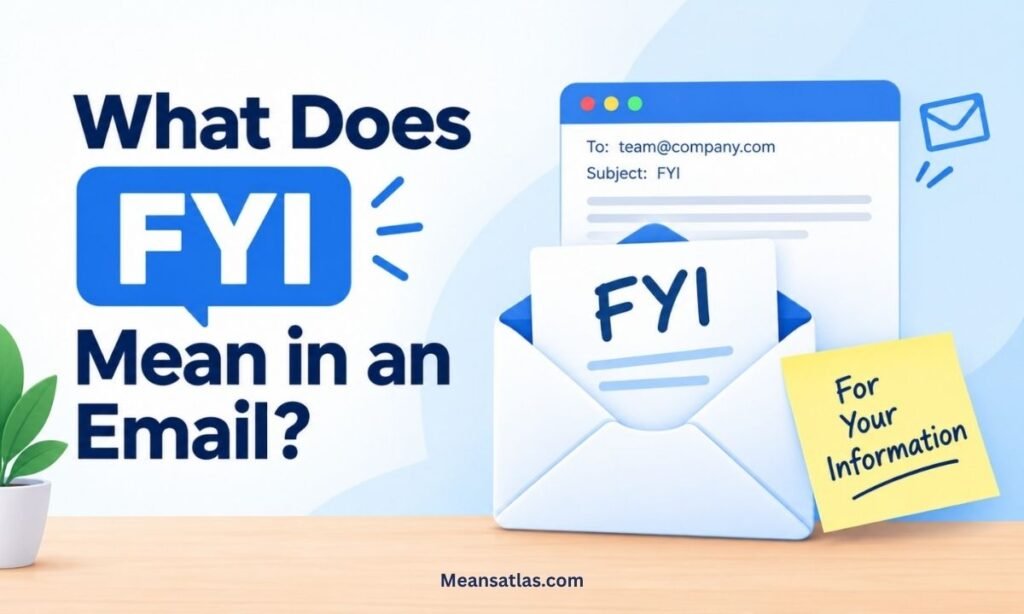
In email, FYI means “this is for your awareness, and you don’t need to act.” People put it in subject lines when forwarding messages: “FYI: Updated schedule.”
Email tips:
- Add one line of context so the reader knows why you sent it.
- State clearly if you need no reply.
- Avoid FYI when you need a decision or an action.
FYI Meaning from a Guy
When a guy uses FYI, it’s usually literal. He wants to pass along information in as few words as possible. Texts like “FYI, I’ll be late” are about efficiency, not emotion.
It can mean more in these cases:
- After an argument: it may signal he feels defensive.
- With a joking tone or emojis: he’s probably teasing.
- In a flirty chat: it can be a playful way to share something about himself.
Read the full message, not just the acronym.
FYI Meaning Rude
Yes, FYI can sound rude. It happens when the sender uses it to correct, scold, or dismiss you.
Examples that can feel rude:
- “FYI, I already said that.”
- “FYI, nobody asked.”
- “FYI, you’re wrong.”
Rudeness usually comes from the sentence around it, not the acronym itself. Short, clipped replies with no emoji make it feel colder. If a message stings, consider whether the sender meant it that way.
FYI Meaning from a Girl
From a girl, FYI follows the same rules: it’s mostly a plain heads-up. Texts like “FYI, I’m outside” are simple and practical.
Context changes the read:
- Friendly chat: she’s just sharing info.
- After a disagreement: it may signal frustration.
- With emojis or humor: it’s likely light and teasing.
Gender doesn’t decide the meaning. Tone, history, and the conversation do.
Common Misunderstandings
1. Thinking FYI is always polite
FYI is neutral, not automatically polite. A blunt “FYI” can come across as cold or passive-aggressive.
2. Assuming it requires a reply
It usually doesn’t. A thumbs-up or a quick “thanks” is enough, and silence is often fine too.
3. Using it in emotional conversations
In sensitive talks, FYI can feel dismissive. “FYI, I’m hurt” sounds oddly detached. Plain, warm wording works better.
4. Overusing it at work
If every message starts with FYI, people may stop reading them. Save it for truly informational updates.
Comparison Table
| Term | Meaning | Tone | Reply needed? |
| FYI | For your information | Neutral | Usually no |
| BTW | By the way | Casual | Sometimes |
| TIL | Today I learned | Casual, curious | No |
| ICYMI | In case you missed it | Helpful | No |
| FYA | For your action | Direct | Yes |
| Just so you know | Same as FYI | Softer | Rarely |
Key Insight:
FYI informs; FYA asks for action. Mixing them up is one of the most common workplace communication slip-ups.
Variations / Types of FYI (Common Uses)
- Heads-up FYI: “FYI, traffic is bad today.”
- Correction FYI: “FYI, the date is the 14th, not the 12th.”
- Attachment FYI: “FYI” with a file or link.
- Playful FYI: “FYI, I’m funnier than you.”
- Defensive FYI: “FYI, I wasn’t the one who said that.”
- Fact-sharing FYI: “FYI, honey never spoils.”
How to Respond When Someone Uses FYI?
Casual Replies
- “Got it, thanks!”
- “Noted 👍”
- “Thanks for letting me know.”
Funny Replies
- “FYI received, filed under ‘important things I’ll forget.'”
- “Thanks for the FYI, my life is now complete 😄”
Mature / Confident Replies
- “Thanks for the update. I’ll take it from here.”
- “Appreciate the heads-up.”
Private / Respectful Replies
- “Thanks for telling me. Can we talk about it later?”
- “I appreciate you sharing this. Let’s discuss it in person.”
Regional & Cultural Usage
Western Culture
In the US, UK, and Canada, FYI is everywhere: workplaces, texts, and social media. Direct communication is common, so a plain FYI is rarely taken personally.
Asian Culture
In many Asian countries, English acronyms like FYI are common in offices and online. Communication can be more indirect, so people may soften it with polite wording, such as “FYI, kindly note…”
Middle Eastern Culture
In professional settings across the Middle East, FYI is widely understood, especially in business English. In personal chats, people often prefer warmer, fuller phrases over short acronyms.
Global Internet Usage
Online, FYI is understood almost everywhere English is used. Its meaning stays the same worldwide, but tone and politeness expectations vary by culture.
Frequently Asked Questions
What does FYI stand for?
It stands for “for your information.”
Is FYI formal or informal?
It’s semi-formal. It’s fine in everyday work emails and casual chats, but avoid it in very formal documents.
Does FYI need a reply?
No. A short “thanks” or a reaction is enough.
Is FYI rude?
Not by itself. It turns rude only when the wording or tone around it is harsh.
What is the difference between FYI and BTW?
FYI shares information you want the person to have. BTW adds a side comment.
What is the difference between FYI and FYA?
FYI means no action is needed. FYA means you should act.
Can I use FYI on social media?
Yes, it’s common for quick updates and corrections.
What can I say instead of FYI?
Try “just so you know,” “heads-up,” or “for your awareness.”
Conclusion
FYI means “for your information,” and in most cases it is just a quick, neutral way to share something. The real meaning depends on tone, relationship, and platform. Use it for simple updates, add context at work, and avoid it when emotions are involved. When you receive one, a brief “thanks” is usually all it needs.

John Marvel is a passionate writer with a strong interest in the meanings of words, phrases, slang, and everyday expressions.
He enjoys researching language and sharing his knowledge to help people understand confusing terms more easily.
His goal is to provide simple, clear, and useful explanations that readers can easily understand and apply.
Through MeansAtlas.com, John shares helpful language insights to make learning and communication easier for everyone.